Saturday, June 25, 2016

LIFE OF MEANING: CHIMP(S)


Sermon Summary, “Life of Meaning: Chimp(s)” June 19, 2016

Ever been to the zoo?  You may find clues to a life of meaning at the Chimp cage.  Picture a cage with a single chimp, then another with two or more.  An observer might day, “One chimpanzee is no chimpanzee.”  Chimps need one another to be chimps.

I have to admit to choosing lonely professions.  The military is highly competitive and frequent moves make it difficult to make close friends.  My Uncle chose an Air Force career and to this day his trusted friends are the ones he made 65 years ago at Annapolis.  I can say that my best friend remains by college best friend.  We need to cultivate friends.

We need friends to talk to confide in to work things out.  And different friends give us  a different perspective.  I have an acquaintance, Greg,  who in testimony tells that it was his Christian small group that saved his marriage.  Another who was head over heels in love and told his Dad, his best friend, that he was leaving his wife.  It was the only way he could be happy.  His Dad told him “You have no right to be happy.  Now get your butt back home and put your marriage back together.”  Guess what?  He did and he was happy.  Intimate friends can enrich your lives and yes, they can also change the direction of your lives.

John Wesley knew that we needed others, friends, to share with and to keep us accountable.  If you were a Methodist, you were part of a small group.  For young people, by gender.  Young men and woman have different problems.  Would my friend Greg above have mentions marriage issues in mixed company? 

As we age, our circle of friends diminishes.  On other fried we can rely on is Jesus.  We can share everything with Jesus.  And why not, he knows everything already!  The Bible has much to say about friends.  Jesus had friends, twelve, and an inner circle of close friends, Peter, James and John.  “Jesus wept” as he approached the tomb of his friend Lazarus. The overarching theme of the Bible is love. Love requires friends.

Who do you have a cup of coffee with?  Are you cultivating your friendships?  Be intentional.  How about with Jesus?  Schedule a coffee time with him, ask him about his life events, baptism, temptations.  Have him ask you about your thoughts, too.

What does it take to be truly human?  The first thig is to Belong to People, a few people that are intimately and permanent part of your lives.  A life without such people might be rich in other terms, but in human terms it is no life at all.  Belong to people.


Saturday, June 18, 2016

LEGACY OR LIFE OF MEANING


Sermon Summary, “Legacy or Life of Meaning?” June 12, 2016

Too often we equate a life of meaning with legacy or greatness: Monumental achievements, writing great books, winning great prizes, scaling mountains.  Great achievements, winning medals may be fine, but do they provide a life of meaning?  Thirty years ago I read a book by Rabbi Harold Kushner which he based on the Ecclesiastes, written by Solomon, who had accumulated more wealth than anyone else, built greater buildings, owned more horses, had more wives and concubines than anyone else, ever, yet in the final analysis he found it all vain, “vanity and chasing after the wind.”  Not treasure, not pleasure, not wisdom, not great works, not sexual conquest, “there was nothing to be gained under the sun.”  (Ecc 2:11b)

Kushner concluded that “it was not immortal deeds that give life meaning, but a lot of little ones, what we do every day.  The challenge is not to rise above the level of everyday life by superhuman effort.  The challenge is to find something truly human to do every day of our lives.”Jesus taught his disciples (and us) something similar: “whoever wants to be first must be last of all and servant of all.” (Mk 9:35)

So our task the next three weeks is to search out those truly human things that can give our lives meaning. 

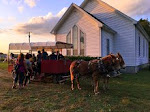
Dorothy and Family.  And Yes, That's "Dorothy Beer"
First a story:  Two weeks ago Rosemary and I attended a surprise 80th birthday party.  It was a surprise on serval levels.  It was not her birthday, and it was not her party.  It was her grandson’s high school graduation party.  Her family was there, and friends, and the town.  The big party was really for Dorothy, a farm wife who had never gone to college, had never written a book, or a poem, had seen the Black Hills but never had climbed them, had never done any of the things that we associate with greatness, but I would suggest she has done all the things Jesus said provided meaning.  She had been married our of high school and had given herself to the family and community since.  After her last child was in school, she got a job in the Soil Conservation office.  If she hadn’t known everyone in the entire county before, she did now.  But that wasn’t all.  After retiring at the age of 65, she got a job cooking at the Senior Center, standing in the serving line conversing with all that came through.  Every day was a day of service.  Every conversation was a truly human conversation.  Everyone knew, really knew Dorothy.

As the party discussions went on, I reflected on church that morning, the front two pews filled with her family, her daughter playing, her grandchildren around her.  She had attended that little church from the time she was a toddler.  This is where she had learned that doing great things didn’t matter, that loving and caring and serving mattered, and that it was truly human things that gave life meaning.  This church is where she learned it, and she lives it. So may we learn it and live it too.


Thursday, May 26, 2016

MAGGIE


Sermon Summary from May 22: “Maggie” (Read Mark 1:40-42; 10:46-52)

I don’t know about you, but I find myself overwhelmed by the challenges of the world and the inadequacies of our response.  We can put our finger anywhere on the globe: 66 dead in the Mediterranean, 5 million refugees in the Middle East.  And we can place our finger in the center of Africa and find untold problems.  Do you know that in the area of the Congo, Burundi and Rwanda from 1993 to 2005 over 5.4 million people were killed in civil war?  More people that in any other conflict since WWII.  I didn’t know.  Maybe we as Americans don’t care what happens there.  But I’m glad that I belong to the body of Christ where people do care.

This sermon falls into the category of “See where God is working in the world and join in.”  We may be overwhelmed.  We may not know what to do, but we can look to see where God is working and join in. What you are about to see is the story about Margarete Barankitse, “Maggie.”  If you don’t catch it, she was a secretary in a church.  It’s amazing who God uses.  I caught this story two weeks ago when she was given the first annual “Aurora Award for Awakening Humanity.” 

The video you’ll see was from 2008.  You remember the genocide in 1993?  Maggie happens to be Tutsi, working in a church where the priests and the nuns were Hutu.  They did not survive.  Just a church secretary, but a Christian who has changed the world.


That was 2008.  Since then the hospital is finished, the biggest hospital in Burundi.  Want to know how the hospital was built?  Asked how she was going to fund it, she said, “God is rich.  He will help.”  The next year she was given the World Award for Children by the Queen of Sweden.  She built the hospital.

And homes.  She decided she didn’t want an orphanage, she wanted homes so she found houses and trained foster parents.  The says the kids have a future because when they leave school they say, “We go home now.”  Her program is called Maison Shalom, “House of peace.”  Peace, not the absence of conflict but a place of harmony.  And she believes in the dignity of people.  She equips them for life and tells them to “Stand up.”  “We want people to help themselves in order to change their lives.”  “Dignity is love.  Humiliation is evil.” 

See where God is working and join in.  I would like you to think about this: Who would Margarete Barankitse be without the church?  Who would have taught her that the “Vocation of Christians is to love”?  Without the church, who would have taught her about the dignity of human life?  She and the church are not just saving children, but giving them dignity.  Equipping them by giving them a home, educating them to stand up, providing microloans for economic development, providing medical care to sustain them and bring new generations into the world.  Such a program is also being done by Keith Jaspers, United Methodist lay person with Rainbow Network.

We cannot all be Maggie Barankitses or Keith Jaspers, maybe none of us.  Yet at one point a single Christian came alongside each one of them and through the faith they passed on, tens of thousands of children have been helped.  When we see someone like them making a difference in the name of Christ, it is our turn to come along aside and join in.  May it be so with all of us.  Amen.

PENTECOST


Sermon Summary from May 15 (Pentecost): “Holy Spirit, Truth Divine” (Read John 14:15-17; Acts 2:1-4)

We didn’t talk about the Holy Spirit did we?  When we grew up it was the Holy Ghost, ghost.  My understanding of ghost was best shaped by Casper.  For the next generation it may have been “Ghost Busters.” (The trailer talks of events of “Biblical Proportions.”)  I’m not sure I had an inkling what the Holy Ghost was about.

Maybe if I had paid a little attention to Charles Wesley’s hymns, e.g. “Come ,Holy Ghost, Our Hearts Inspire.” In the second verse we find how the Holy Ghost spoke in the Old Testament: “for by Thee the prophets wrote and spoke.”  God was selective in his Spirit and in his choice of prophets and times, but then when I look at the wonder of Isaiah or Jeremiah or Ezekiel, I can see the presence of the Holy Ghost.  Later the prophet Joel would tell us “Then...I will pour out my spirit on all flesh.”  That’s what happened at Pentecost.  God poured out his Spirit on all flesh.  That’s all of us!  All of us who make ourselves aware of the prompting and say “Yes” receive the Spirit!

In the story in Acts, the Spirit gave the ability to tell the Good News in many languages, but it was much more than just about communications.  John tells us that this Advocate (a helper who comes along side) will abide in us and be in us. In John 16 he tells us he will teach us all truth.  That is the Holy Spirit I want to talk about.

The New Testament moves from the OT “thou shalt nots” which seem easy to understand (but maybe difficult to obey), to open ended commands of Jesus.  In John we are told to “keep the commandments,” to love one another, to believe (and not just to mentally believe, but to take it to heart and act on that belief)  These are difficult things to know, let alone do.  Who am I to love?  How am I to love?  What am I to do?  (These are the Jiminy Cricket questions of the James series: “But how will I know?)”  If we are listening to the Spirit, if we are to live by the Spirit, we will be guided by the Spirit.  That’s how.

The New Testament even gives us a checklist, an examination of where we have been each day.  For example, we ask, “Because of what I’ve done today, is there more love in the world than yesterday?”  Or joy, or peace, or patience, or kindness, or goodness, or faithfulness or gentleness, or self-control?  We call these the Fruit of the Spirit (Gal 5:22-23).  We seek to be faithful to the commands of Jesus, we listen to the Spirit to see how we are to do that, we review our lives in terms of the Fruit of the Spirit we produce.  A powerful helper indeed!  Amen.


Saturday, May 14, 2016

MOTHER'S FORGIVENESS


Sermon Summary from May 8: “Mother’s Forgiveness” (Mt 6:14; Col 3:12-15)

Happy Mother’s Day! One of our recently requested sermons was on forgiveness, and since I believe that mothers are the most forgiving creatures in the world, I thought this would be a great day for that sermon.  Of course mothers are incredibly forgiving of their own, but they are also protective of their own. It’s in their DNA.  And when that protective instinct is challenged, forgiveness can be difficult.

When that protective instinct is challenged, feelings of anger, retribution, contempt or judgment arise.  Without forgiveness it can harm us, harm our relationships, harm others.  Hear this: Jesus does not want you harmed! He has given us a pathway to forgiveness (“as we forgive those…), and he says we must!  (“You must forgive.”)

A Story: Scarlett Lewis prepared her six year old son, Jesse, for school, followed him out to his ex’s car, took a picture of him before he drove off.  It would be her final picture, because Jesse was being dropped off at Sandy Hook elementary.  Here’s the question, will Scarlett allow herself to be consumed, destroyed by bitterness or will she find a pathway to forgiveness?

Before answering, another story.  A pastor and his wife lose a son to a crackhead murderer.  The husband, Walt, cannot get over it, pushes his wife away, is transferred to another congregation, his life in shambles.  Eventually, he attends the killers sentencing and a month later writes him, then later visits him in prison.  Four years later he testifies at Michael’s parole hearing and five years after that he marries he and his bride.  Forgiveness was reluctant, slow, but Michael has become a productive member of society, Walt a productive pastor once again.

I wish I could say that Walt’s wife Izzy’s life had been restored, but it was not.  Sometimes when we harm others, the harm cannot be undone.

That’s why God insists we forgive.  He gives us no choice.  Forgiveness is a choice, our choice, but we can’t do it alone.  We need grace present with us, nudging us, prodding us.  The most difficult part of loving our neighbor is forgiving them.  But we need to say “Yes.” 

Scarlett Lewis says that without forgiveness it was like she was tethered to Adam Lanza, the Sandy Hook killer.  Forgiving him set her free.  Eventually, through stops and starts she learned to have compassion for him and for his mother who enabled him.  For her forgiveness was choice girded by grace, and it saved her. So may it be with us.  Amen.


JIMMY'S WAR OF WORDS


Sermon Summary from May 1: “Jimmy’s War of Words” (Read James Chapter 3:1-10; 4:11-12)

I don’t know about you, but I’m tired of name calling.  Words can be off-putting; or words can inspire you.  Can’t we have more of the latter.  Can’t we hear Churchill inspiring a nation to fight on and win, “We will never surrender.”  Can’t we hear Kennedy leading a nation to “put on man on the moon in this decade and return him safely to earth”? 

Unfortunately, words can harm.  James (Jimmy as I call him) warns us that the tongue is a fire that can set a whole forest ablaze (James 3:5-6).  A tongue can do harm.

John Wesley admonished us to  “First, do no harm.”  We can do harm with our words and once spoken can never be recalled.  I think that’s why Paul told us in Ephesians 4:29, “Let no evil talk come out of your mouths , but only what is useful for building up, as there is need, so that words give grace to those that hear.”  Let that be a reminder that even when we need to critique another, we need to use words gracefully or they will not be heard.

James concludes, “with [the tongue] we bless the Lord and Father, and with it we curse those who are made n the likeness of God.  From the same mouth come blessing and cursing.  By brothers and sisters this ought not be so.”

So what are we to do?  We can’t stop talking.  The antidote come from Jesus’ Sermon on the Mount.  “Blessed are the pure in heart…” With a pure heart we see the world in a positive light.  We treat others with respect.  And before we speak, we listen to our conscience.  Stephen Covey teaches that between any stimulus that might make us respond inappropriately, is a space, a moment in which we can choose.  We can choose to respond gracefully.  We can choose to respond with respect.  We can choose to respond civility.  It may required sacrifice on our part, but we can choose.

One of my favorite authors is Stephen Carter, Yale law professor and  lay person.  In Civility he writes, “Civility is the sum of all the sacrifices we make for the sake of living together...The rules of civility are also the rules of morality.  It is morally proper to treat others with respect, and it is morally improper not to.”

Morally proper: First, (choose to) do no harm.  Next, “Do unto others as you would have then do unto you.”  Build others up with your words.  Show them grace.  Amen.


Saturday, May 7, 2016

JIMINY JUDGMENT


Sermon Summary from April 17: “Jiminy Judgment” (Read James Chapter 2:1-13)

The Letter of James, “The Gospel According to Jimmy,” is a letter of grace, of prevenient grace, a book of conscience, nudging us to do what Jesus says to do.  When we respond to that nudging we have the opportunity to change.  We Methodists call that nudging grace.  Some would call it conscience.  At Easter we talked of God loving us just as we are.  God loves us just as we are, but doesn’t leave us as we are.  He nudges, uses conscience.  We respond, we change.  Last week we said that the Letter of James was a side-kick to Jesus’ Sermon on the Mount, and we introduced another side-kick, Jiminy, conscience too, as he did for Pinocchio, show us right from wrong.

So we jump in.  “Religion that is pure and undefiled before God.. is this: to visit orphans and widows in their affliction..”  Widows and orphans are at the bottom of the totem pole in biblical times.  God favors them even when we do not.  James calls us our for our favoritism, favoring the rich and well dressed over the poor and shabby.  We dishonor the poor!  We are partial.  We are judgmental!  (Read again James 2:1-13)

You had to be there for the story about Wilkes Blvd UMC, but let it be said, we are partial even in the present day!  James, Jimmy, says “If you show partiality, you are guilty of transgressing the whole law!”  Jesus says (and you know this one even if you’ve never opened the Bible) “Judge not, lest you be judged.”  “Why do you see the speck of sawdust in your neighbor’s eye but do not even notice the plank in your own eye?... You hypocrite.” How many specks of sawdust in a plank? A trillion?  Before we judge we must remember our own condition is a trillion times worse!

Important distinction between discernment and judging.  With discernment we compare things, right and wrong, an essence part of conscience.  We must discern.  With judgment we compare others and diminish them.  Judge not!  Unfortunately, there is a little judgmental Pharisee in each of us.  When we find ourselves beginning to be partial or judgmental, we must listen to the promptings of Jiminy, of conscience.  Judging, whether economic, social or racial, is evil.  Even the Church is in trouble because we are perceived (and rightly so) as judgmental.  We as the Church are witnesses to Jesus Christ and must do so by following his footsteps, doing as he would do—Judging not.  So may it be with all of us.