Showing posts with label Renovate or Die. Show all posts

Saturday, June 5, 2010

Strategy #4 "Create Momentum"

The Strategy Themes discussed below were presented by Bob Farr, Director of Congregational Excellence, Missouri Conference UMC, as part of a presentation “Renovate or Die: How to Become an Outwardly Focused Church.” The following discusses Strategy #4 of 10.

Strategy #4 Create Momentum

Or how to break through resistance and lead change!

Leaders motivate. Managers channel that motivation. In the case of “Creating Momentum” both are clearly needed. Channeled activity without motive is doing the same old thing. Motivation without direction is simply chaos. Momentum mathematically is a “vector,” ie it has a direction as a component. In other words, it is channeled energy. So the leader’s task is to achieve channeled energy that moves the congregation toward his or her vision.


So how does a pastor create momentum? What does he or she focus on? Buckingham and Coffman, First Break all the Rules (pg 57) say emphasize your strengths. Jim Collins, Good to Great, says select something you can do world class, that you are passionate about, that makes the biggest difference (he says “economic denominator”; I say that produces the most "extravagant generosity" or the most "radical" participation by your congregation.)

What can you do world class, better than anyone else? Everyone has something. Our little church does Vacation Bible School (VBS) world class. We have an average attendance of 19 that includes two children. Yet we had 18 kids in VBS last year with a teenage dancer leading awesome music, in a multipurpose barn a half mile from the church, with a neighbor mom, home schooler, as a wonderful Bible teacher. To be world class, we didn’t just depend on our own resources, we used the community. And we had fun! Three years ago it rained. One of the mothers rounded up 10 plastic water bottles and tennis balls, and we did VBS bowling down the church aisle. The first one to 153 (the number of fish caught in John 24) won. And we had fun. (Two years later, Cokebury used the same game as one of its recreation programs.) Did I say 18 kids?

The intersection of what you are passionate about, what you can do world class, and what radically maximizes participation should be the fruitful ministries that are your focus. Then Collins says the best achieve success over and over again creating an accumulation of visible results that energize their companies (congregations). Momentum builds and bursts through resistance to change!

Success is best visible in PRAY-PLAN-DO-CHECK-ACT cycles. Rick Warren says, “[Practices] must be put into a sequential process [to] be acted on every day.” Bishop Schnase says, “Exemplary and repeated practices.. are the means congregations use to fulfill their missions with excellence and fruitfulness [changing lives in Jesus Christ].”

Create momentum by doing what you are passionate about, what you do best, what brings extravagance and radical participation and do it in an exemplary and repeated manner… Changing lives in Jesus Christ!

Bob’s Farrism: “Successful churches do what unsuccessful churches refuse to do.”

Friday, May 28, 2010

Strategy #3 Begin With the Basics

The Strategy Themes discussed below were presented by Bob Farr, Director of Congregational Excellence, Missouri Conference UMC, as part of a presentation “Renovate or Die: How to Become an Outwardly Focused Church.” The following discusses Strategy #3 of 10.

Strategy #3 “Begin with the Basics.”

“May a joyful noise to the Lord, all the earth!”

Bob suggests “Start with great worship, great music, great children’s programs, do the Five Practices well.” That would be quite a report card. Even Adam Hamilton says Church of the Resurrection gets a “B” in worship. (That’s enough for the rest of us to revise our report cards.) So where in the world do we begin? I would suggest with what you do well and make it better.

Edward Deming is the Father of total quality management that revolutionized the Japanese automobile industry. The heart of it is the simple “Deming Cycle”: Plan, Do, Check, Act (and I would suggest immersed in prayer). Again, Adam Hamilton reports that the worship team meets every Monday to review how the worship weekend went and how they can do better. Not only that, Rev. Hamilton has an associate monitor his Saturday night sermon to make recommended changes for the Sunday services. Would we be so bold? Pray, then Plan, Do, Check Act, and Pray. By the way, without a team accountable to make what the activities better, your church will not be intentional or successful in your effort. The best team is the team of doers. James was right, “Be doers…, not merely hearers.” Then the gospel according to Deming says, “Then do it better, one step at a time. Plan, do, check, act.”

Small churches believe they are strapped from doing great things by limited resources. God uses others; we should too. There are talented people in our communities who are just waiting for our invitation to make a joyful noise or to lead Vacation Bible School (VBS). Want to have a great VBS? Find a teenager in your neighborhood who loves to dance and sing. Give her the Cokesbury CD and Music Director’s book a month in advance and watch your VBS blossom. Young girls will admire her, and well, boys will be boys.

Children’s programs, VBS, Sunday School, Youth Programs need to be fun. Kids learn and are attracted to the faith in fun environments. Jesus called himself a “bibber.” Can you imagine what He might have been like as a child? Make fun foundational and you will have the beginnings of a great children’s program.

Then Practice, Practice, Practice, Practice, Practice (that’s five). And “Make a joyful noise.”

Tuesday, May 18, 2010

Strategy #2 "Understand Your Present Realities"

The Strategy Themes discussed below were presented by Bob Farr, Director of Congregational Excellence, Missouri Conference UMC, as part of a presentation “Renovate or Die: How to Become an Outwardly Focused Church.” The following discusses Strategy #2 of 10.

Strategy #2 “Understand Your Present Realities”

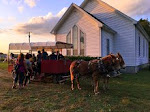
The house closest to our 175 year old country church is a fairly new modular home where a single dad, his child and girl friend reside. He is one of the 80 plus percent of the people in our neck of the woods for whom church attendance is not important. Chuck does not look like our church. The neighborhood has changed. Rather than a farm community, it more closely resembles suburbia with residents traveling to a half dozen communities for their labors instead of making their living off the farm. There are few ties to the land. So not only Chuck, but most of our neighborhood does not look like the church.

Some of our church members live on 100 year old farms. Many, many of the neighbors are new and younger and living on smaller parcels of land. Because of that, the church doesn’t know their neighbors. The church members were high school classmates of 1964 and their parents. The neighbors don’t do 4H or woman’s groups with the church members. They don’t go to the sale together, because the neighbors don’t go. Most are not sure who’s behind the new mailboxes.

(By the way, if asked, most of the members would say there’s nobody around here anymore (that looks like them). Yet, a missioninsite listing within a six mile radius returned 800 mailbox addresses!)

In the book Stones into Schools, the story of Greg Mortenson planting girl’s schools in Afghanistan, he tells of visiting a US Army fire base where the operations center tracked not intelligence on the enemy but the culture of villages, the clans, the households, everything imaginable about the community the battalion was trying to secure. Mortenson gave them high marks for their efforts to know those they were sent to serve. What if we were to strive to know as much about the communities in which we live?

Just this week, I had an Edward Jones broker knock on my door, telling me (I’m sure his tongue was in his cheek), “I’m not here to sell anything. I’m just trying to get to know the neighborhood.”

It’s easier if we have a reason to talk to people. We need to continually make reasons for invitation, reasons to knock on doors, reasons to start conversations, reasons to ask neighbors to participate with us. Adam Hamilton says that today the reason may more likely be a means of service, in a food pantry, at a Habitat work site or other work project. Some rural churches piggy back with bigger churches to offer Angel Food Ministries to their neighborhood. Servant evangelism does work. Whatever it is, we need to be searching for reason for invitation. Rick Warren calls them “bridge events” into the neighborhood. How many, how often? As many as the resources of your congregation will allow: three, five, seven times a year.

And teach your congregations they don’t have to be a theologian, they don’t have to be an evangelist. All they have to do is be able to say is “I go to church. Church is important to me. Church makes a difference in my life. Won’t you join me this Sunday.” Then make sure you give them something to take away.” (Rev. Ross Reinhiller, who grew his church from 175 to 350 attendees in 2 years in a town of 3500 people.)

Get your thinking caps on. What is your church’s reality? What do you need to do to bridge to the new reality? How do you become missional? What do you need to change to give them something to take away, something important to them?

PS. Bob’s Farrism is “Connecting to context is everything.”